Restorations
Implant-supported teeth: a tooth and its root, restored
Implant-supported teeth replace a missing tooth and its root with a small post in the jaw and a tooth on top. This guide explains the parts, steps, costs, timeline, and trade-offs in plain language.
What implant-supported teeth are
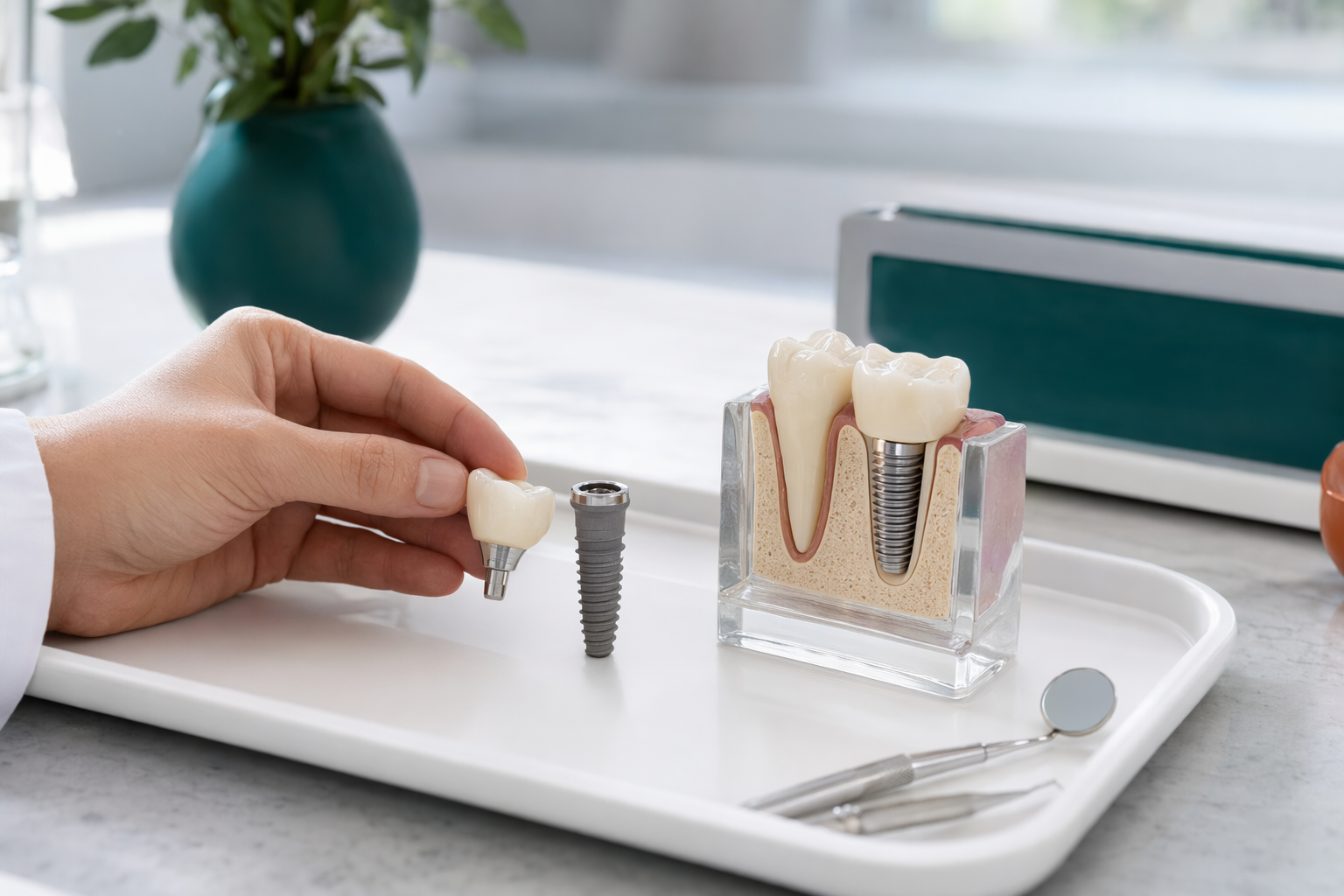
An implant restoration usually has 3 parts: the implant post placed in the jawbone, the connector above it, and the visible tooth or teeth attached on top. The top part may be a single crown, a bridge that replaces several teeth, or a denture that snaps or screws onto implants.
This is different from a regular bridge or denture because the restoration is supported by implants in the jaw, not only by nearby teeth or the gums. Many people like that it can feel more secure and can help with chewing, but it also usually takes more time, planning, and money.
Implants are used for tooth replacement, but not every mouth is the same. Bone amount, gum health, the number of missing teeth, and overall dental condition all matter. Only a licensed dentist or specialist who examines you and reviews images can say what options fit your situation.
RestoreBite is a free matching service, not a dental practice. We do not provide dental care or treatment advice. We help people connect with licensed restoration dentists and prosthodontists through our free service and matching page.

Materials: what the parts are made of, and the trade-offs
The implant post itself is most often titanium. In some cases, zirconia implants may be discussed. Titanium has the longest track record and is widely used. Zirconia may appeal to some people for metal-free reasons, but availability, planning, and long-term evidence can differ by case and area.
The visible tooth on top can be made from porcelain, zirconia, metal-ceramic, acrylic, or a mix of materials. A single implant crown is often porcelain or zirconia. Full-arch teeth on implants may use acrylic over a framework, or stronger ceramic or zirconia designs.
Each material has trade-offs. Porcelain and zirconia can look natural, but cost may be higher. Acrylic can cost less and may be used in full-arch cases, but it may wear faster. Stronger materials can also be harder to adjust or repair. What works well depends on where the tooth is, bite forces, appearance goals, and budget.
Ask for the material to be written on your treatment plan, not just spoken aloud. If the office uses vague words like "premium" or "best" without naming the material, the warranty terms, and what is included, slow down and ask for details in writing.
How the process usually works
Implant treatment usually happens in stages, not all at once. The exact process depends on whether you need one tooth, several teeth, or a full arch, and whether bone grafting, extractions, or gum treatment are needed first. Some people receive a temporary tooth during healing. Others wait until the implant has healed before the final tooth is attached.
A typical process may look like this:
1. Exam, images, and planning.
2. Placement of the implant post in the jaw.
3. Healing time while the bone bonds to the implant.
4. A connector is attached, or the implant is uncovered if needed.
5. Impressions or digital scans for the final crown, bridge, or denture.
6. Delivery and fit adjustments.
For a straightforward single implant, the timeline may be a few months. If you need grafting, multiple implants, full-mouth work, or healing after extractions, it can take longer. Same-day temporary teeth are possible in some situations, but that does not always mean the final restoration is done that day.
Before starting, get a written treatment plan and written price. It should show each stage, what is included, the material, who is doing the work, estimated timing, and the cost if extra procedures are needed.
How long implant restorations typically last
Implants can last many years, but no restoration lasts forever. The implant post itself may last a long time if it heals well and is maintained, while the visible crown, bridge, denture teeth, screws, or attachments may need repair, replacement, or tightening sooner.
A single implant crown may last 10 to 15 years or longer in some cases. Full-arch implant restorations can also last many years, but parts such as acrylic teeth, clips, or attachments may wear and need service. Bite habits, smoking, cleaning, grinding, gum health, and regular follow-up all affect longevity.
Long-lasting does not mean maintenance-free. Implant restorations still need cleaning and checkups. If an office suggests implants are a permanent fix with no future upkeep, be careful. Ask what maintenance is normal, what problems are common, and what future repairs might cost.
Honest cost ranges and what changes the price
Implant restorations are often among the more expensive ways to replace missing teeth. In the United States, a single implant with the post, connector, and crown may often total about $3,000 to $6,500 per tooth. An implant-supported bridge can run several thousand dollars more depending on how many teeth are replaced and how many implants are used. Implant-supported dentures may start around $6,000 to $15,000+ per arch for simpler removable designs, while fixed full-arch implant teeth are often much higher, commonly around $15,000 to $35,000+ per arch.
These are broad educational ranges, not quotes. The real number depends on the material, the number of teeth, your mouth and bone condition, whether teeth must be removed first, whether bone grafting or sinus work is needed, who provides the treatment, and the area of the country. A prosthodontist or surgical specialist may charge differently than a general dentist, and lab costs vary too.
Costs often go up with more implants, more complex surgery, stronger or more cosmetic materials, temporary teeth, sedation, grafting, and full-mouth planning. Costs may be lower for removable implant overdentures than for fixed full-arch teeth. You can read more general pricing information on our costs page.
Watch for pressure tactics: vague pricing, same-day pressure to start, no written treatment plan, no second opinion offered for a big case, or cash-only demands without clear documentation. For large implant plans, many careful people get a second opinion and compare written plans line by line.
Who implant-supported teeth may suit, and how they compare with other options
Implant-supported teeth are often considered when a person wants to replace a missing tooth root as well as the visible tooth. For one missing tooth, they may be compared with a traditional bridge or, in some cases, a removable partial denture. For many missing teeth, they may be compared with full or partial dentures and non-implant bridges.
Compared with a regular bridge, an implant may avoid relying on nearby teeth for support. Compared with a removable denture, implant support may offer more stability. The trade-offs are usually higher cost, longer treatment time, surgery, and the possibility of added procedures such as grafting.
This does not make implants automatically "better" for every person. Some people prefer a lower-cost or faster option. Others may not want surgery. A licensed dentist who examines your mouth can explain which choices are realistic and what each one gives up.
If you are comparing options, our questions to ask before a restoration can help you slow the conversation down and ask for clear answers.
How to find a licensed dentist for implant restoration
Look for a licensed dentist or prosthodontist with clear experience in restorative implant work. In some cases, treatment involves more than one provider, such as a surgeon who places the implant and a restoring dentist who makes and fits the tooth. Ask who is responsible for each stage.
A good consultation should leave you with a written plan, not confusion. Ask for the diagnosis in plain language, the treatment steps, the materials, the number of visits, who performs each part, the estimated timeline, the full price range, and what follow-up or maintenance is expected.
Use this checklist:
- Verify the dentist's state license.
- Ask whether they regularly restore implants similar to your case.
- Ask what material will be used for the final tooth or denture.
- Ask what is included in the price and what is not.
- Ask whether temporary teeth, extractions, grafting, scans, and repairs are separate costs.
- Ask what happens if the case takes longer than expected.
- Get a written treatment plan and written price before you start.
- Consider a second opinion for any large or expensive plan.
RestoreBite is free for patients. We are not a dental office, and we do not collect medical or dental history. We only collect basic contact details and the type of restoration you are asking about so we can help you connect with licensed providers near you. If you want help, you can get matched. If you have a true dental emergency such as severe swelling, high fever, uncontrolled bleeding, or a knocked-out tooth, seek urgent or emergency care first.

Implant-supported teeth can be secure and long-lasting, but they usually cost more, take longer, and should only be chosen after a licensed dentist gives you a written plan and price.
Common questions
Is an implant the same as a crown?
No. The implant is the post placed in the jawbone. The crown is the visible tooth attached on top through a connector.
How long does a dental implant take from start to finish?
Often a few months for a simpler case, but it can take longer if extractions, healing, bone grafting, or full-mouth work are involved. The timeline varies by person and treatment plan.
How much does one implant tooth usually cost?
A single implant with the post, connector, and crown often totals about $3,000 to $6,500 in the US. That is a broad range, not a quote, and the real price depends on materials, complexity, and location.
Are implant-supported dentures removable?
Some are removable and snap onto implants, while others are fixed and only the dental office removes them. Which type is offered depends on the treatment plan.
Do implant-supported teeth last forever?
No restoration should be promised to last forever. Implants can last many years, but crowns, denture teeth, screws, clips, and other parts may need maintenance, repair, or replacement over time.
How do I know if a dentist is pushing me too fast?
Be cautious if pricing is vague, you are pushed to start the same day, there is no written treatment plan, or a second opinion is discouraged. For a big implant case, ask for the plan and price in writing before agreeing.