RestoreBite
Ways to restore your teeth
If you are comparing ways to replace or repair teeth, this page lays the main options out in plain language. RestoreBite is a free matching service, not a dental practice, and this is general educational information only.
Find a restoration dentist — free
What a dental crown is, the materials (zirconia, E.max, PFM, gold), how it's done, how long it lasts, what it costs, and how to find a dentist who does crowns well.
See the details → Dental bridges: replacing one to three missing teethHow a dental bridge replaces missing teeth, the types (traditional, cantilever, Maryland, implant-supported), what it costs, how long it lasts, and the trade-offs vs an implant.
See the details → Partial dentures: when some teeth are missingHow partial dentures work when you still have some natural teeth, the materials (acrylic, cast metal, flexible), comfort and fit, cost ranges, and how they compare to a bridge.
See the details → Full dentures: replacing all the teeth in an archHow full (complete) dentures work, conventional vs immediate, the fitting process and adjustments, what they cost, how long they last, and implant-supported alternatives.
See the details → Implant-supported teeth: a tooth and its root, restoredHow an implant-supported crown, bridge, or denture restores a missing tooth and its root, the stages and timeline, what it costs, how long it lasts, and who's a candidate.
See the details → Full-mouth restoration: rebuilding the whole biteWhat full-mouth restoration involves, how a dentist plans a staged rebuild with crowns, bridges, and implants, realistic timelines and cost ranges, and why a second opinion matters.
See the details → What a prosthodontist is — and when you need oneA prosthodontist is a dentist with extra training in restoring and replacing teeth. What they do, when a general dentist is enough, and how to find the right one for complex work.
See the details →The main ways teeth are restored
Dental restoration is a broad term. It can mean covering a damaged tooth, replacing one missing tooth, replacing several teeth, or rebuilding a full smile when many teeth are missing or badly worn.
The main categories are dental crowns, dental bridges, partial or full dentures, and implant-supported restoration. Some people also hear the term full-mouth restoration, which usually means a larger plan involving multiple teeth and sometimes more than one type of restoration.
Which option a dentist may discuss depends on how many teeth are involved, where they are in the mouth, the condition of the gums and jawbone, the materials used, and your local area. This page is not treatment advice. A licensed dentist or prosthodontist needs to examine you before saying what may fit your situation.
What each option does
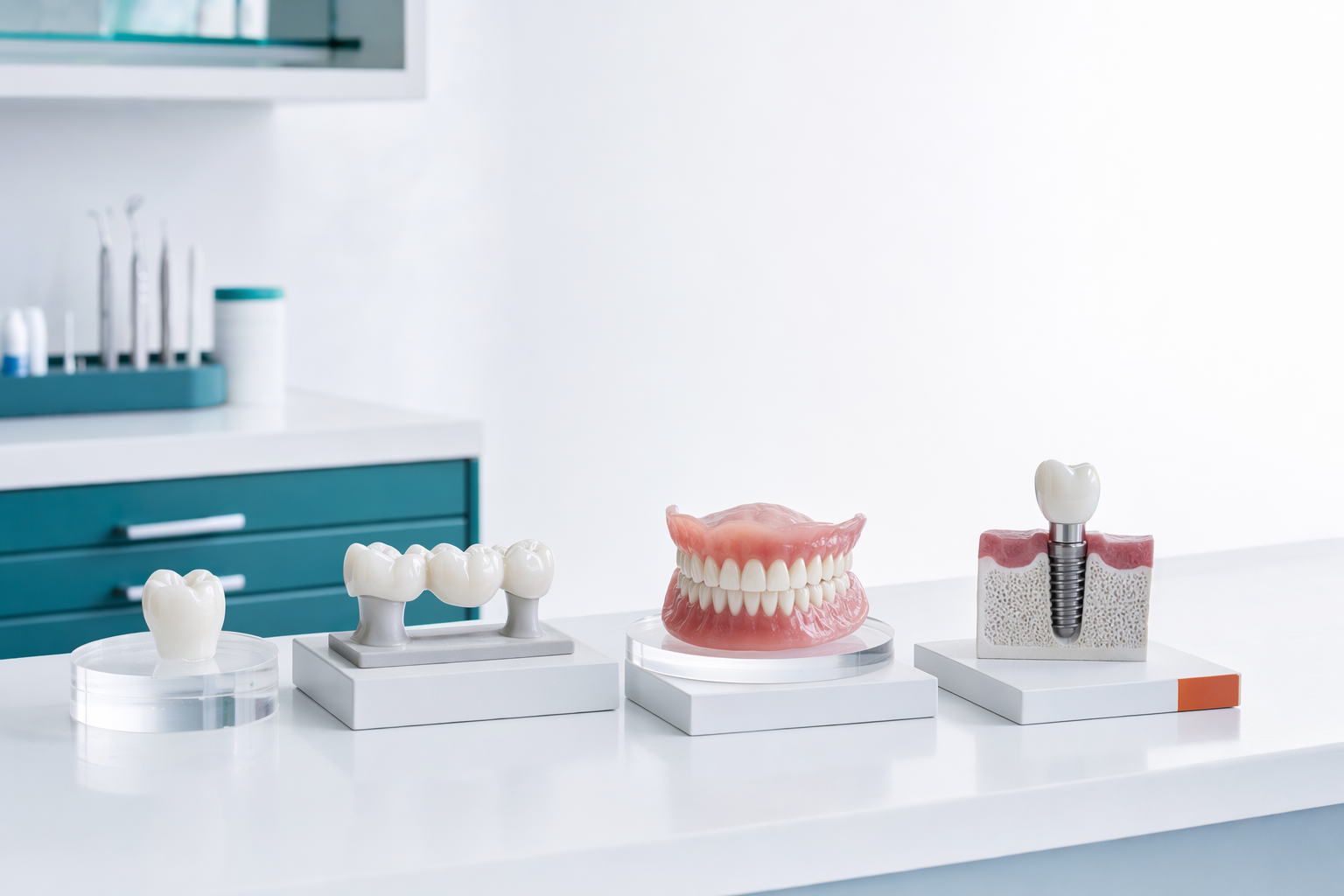
A crown is a cap that covers a damaged or heavily filled tooth. It is used when the tooth root is still there and the tooth can be restored rather than removed. Crowns are often made from porcelain, zirconia, metal, or mixed materials.
A bridge replaces one or more missing teeth by attaching an artificial tooth to neighboring teeth or to implants. A traditional bridge usually depends on the teeth next to the gap. An implant-supported bridge depends on implants instead.
A partial denture replaces several missing teeth and can be taken out for cleaning. A full denture replaces all teeth in the upper arch, lower arch, or both. Implant-supported teeth may mean a single implant crown, an implant bridge, or a denture that snaps onto implants for more support.
Full-mouth restoration is not one product. It is a broad term for rebuilding many teeth at once, often because of heavy wear, many missing teeth, or a combination of damage and tooth loss.
How long they may last
No restoration lasts forever, and no website can promise how long one will last for you. Lifespan depends on the material, bite forces, daily cleaning, smoking, teeth grinding, gum health, and the skill of the treating dentist and lab.
In general, crowns and bridges may last many years if they fit well and are cared for. Dentures may need relining, repair, or replacement over time as the gums and bone change. Implant-supported work can also last many years, but it still needs regular care and can have complications if the gums or bone around the implants become unhealthy.
A useful question to ask at a consultation is not only "How long can this last?" but also "What maintenance, repairs, or future replacements are common with this option?"
Typical cost ranges in the US
Costs vary a lot by city, material, the number of teeth, the condition of the mouth, and whether extra work is needed first. These are general US ranges, not quotes.
- Crown for one tooth: often about $800 to $2,500+
- Traditional bridge: often about $2,000 to $5,000+ depending on the number of units
- Partial denture: often about $700 to $3,000+
- Full denture for one arch: often about $1,000 to $4,000+
- Implant with crown for one tooth: often about $3,000 to $6,500+
- Implant-supported full-arch restoration: often about $15,000 to $40,000+ per arch
- Larger full-mouth restoration plans: sometimes much more, depending on how many teeth and procedures are involved
What pushes the cost up or down: stronger or more natural-looking materials, how many teeth are being restored, bone grafting or extractions, temporary teeth, sedation, lab quality, and the local market. You can read more on our costs page.
Be careful with very low advertised prices that leave out key parts of the plan. Ask for the full written treatment plan and the full written price before agreeing to anything.
How to compare options carefully
When people feel rushed, expensive dental plans can become confusing fast. It is reasonable to slow down, ask for plain explanations, and compare more than one opinion for major treatment.
- Ask what problem each option is meant to solve.
- Ask what teeth or structures would be kept, reduced, removed, or replaced.
- Ask how the restoration is supported: natural teeth, gums, implants, or a mix.
- Ask about maintenance, future repairs, and likely replacement over time.
- Ask for a written treatment plan and a written total price.
- Ask what is not included in the price.
- For larger plans, get a second opinion.
Watch for pressure tactics:
- vague pricing
- pressure to start the same day
- no written treatment plan
- no second opinion offered for a big case
- cash-only demands without clear documentation
It is also smart to verify that the dentist is licensed in your state. If a plan is complex, many people also ask whether a prosthodontist is involved, since prosthodontists focus on restoring and replacing teeth.
How RestoreBite can help
RestoreBite does not provide dental care, diagnoses, or treatment. We are a free matching service that helps people connect with licensed restoration dentists and prosthodontists near them.
We only collect basic contact details and restoration-type interest so we can try to match you: name, phone, optional email, ZIP code, preferred language, and the type of restoration you are asking about. We do not ask for medical or dental history, medications, insurance numbers, bank information, or Social Security numbers.
If you want, you can explore specific pages for crowns, bridges, full dentures, and implant restoration. If you have a true dental emergency such as severe swelling, high fever, uncontrolled bleeding, or a knocked-out tooth, seek urgent or emergency dental care first.
Crowns, bridges, dentures, and implant-supported teeth each solve different problems, and the safest way to compare them is to get a written plan and price from a licensed dentist without feeling rushed.
Ready to restore your bite?
Get matched, free, with a restoration dentist near you. Contact and restoration type only — no medical or dental history. You get a written plan and price before any work starts, and you choose who to see.