Restorations
Partial dentures: when some teeth are missing
A partial denture replaces some missing teeth when you still have natural teeth left. It can be a lower-cost way to fill gaps, but comfort, fit, and price depend a lot on the design, materials, and your mouth.
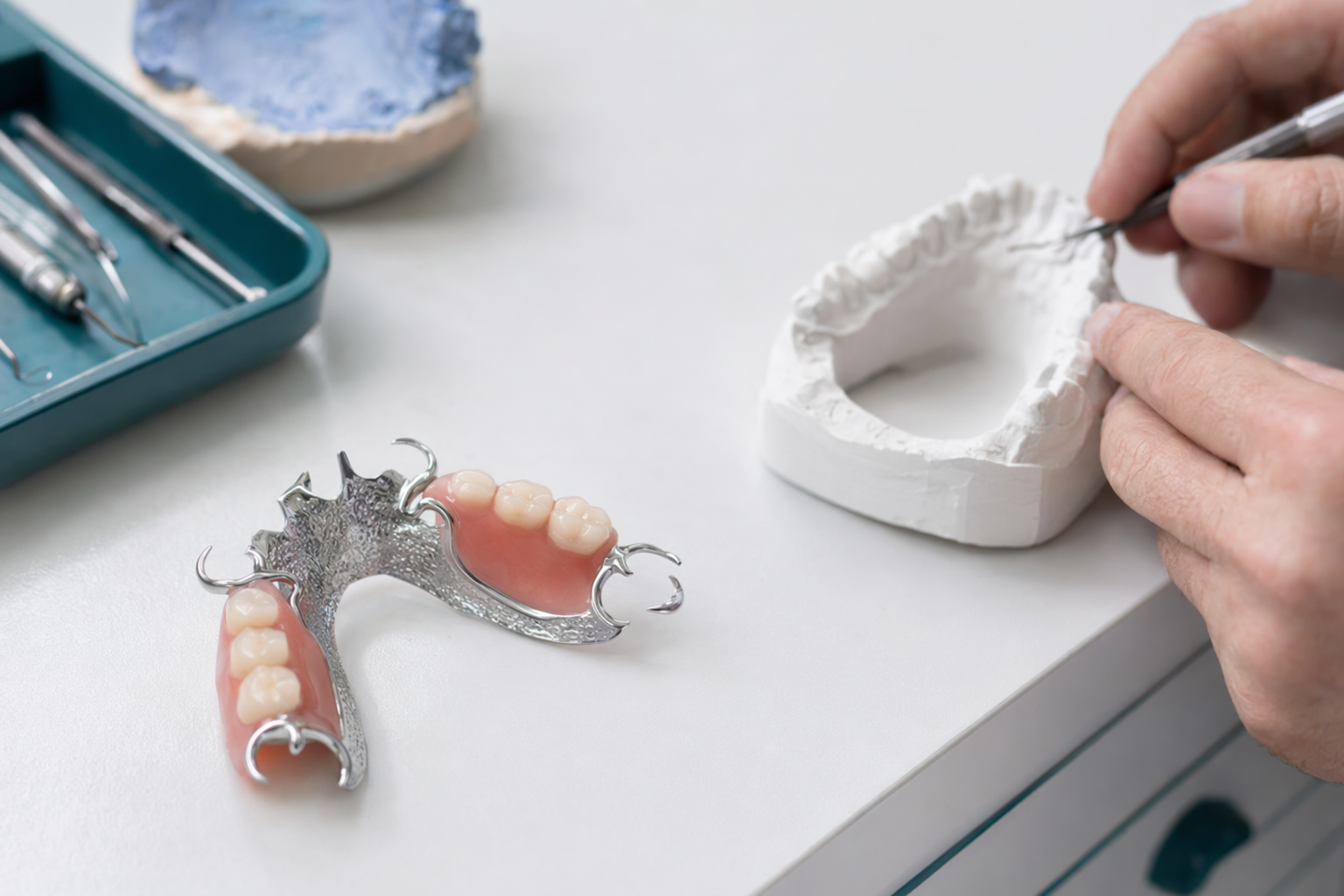
What a partial denture is
A partial denture is a removable replacement for several missing teeth. It usually has one or more artificial teeth attached to a base, and it uses your remaining natural teeth and gums for support.
Unlike a full denture, it is made for someone who still has some healthy teeth. Some partials clip around natural teeth. Others fit more tightly and spread pressure across the mouth in a different way.
This page is general, educational information only. RestoreBite is a free matching service, not a dental practice, and we do not provide dental care. A licensed dentist or prosthodontist needs to examine your mouth to say what options may fit your situation.

Common materials: acrylic, cast metal, and flexible
Partial dentures are not all made the same way. The material affects how bulky it feels, how strong it is, how it looks, and how much it usually costs.
Acrylic partials often have a thicker pink base with replacement teeth attached. They are commonly used as a lower-cost option, and sometimes as a temporary or transitional solution. Trade-offs: they can feel bulkier, may break sooner than stronger designs, and may need more adjustments.
Cast metal partials usually have a thin metal framework with acrylic and artificial teeth added to it. They are often slimmer and sturdier than all-acrylic designs. Trade-offs: they usually cost more, and some metal parts may show depending on the design.
Flexible partials use a bendable gum-colored material instead of a rigid metal framework. Some people like that they can look less noticeable and may feel more comfortable at first. Trade-offs: they are not right for every mouth, can be harder to adjust or repair in some cases, and may not provide the same support as a well-made cast metal design.
How the dentist makes it and how many visits it takes
The exact process depends on the type of partial denture and the condition of the remaining teeth. In many cases, it takes a few visits over several weeks rather than one same-day appointment.
A common process looks like this:
1. Exam, discussion of options, and impressions or digital scans.
2. Measurements of your bite and planning for how the partial will sit around your natural teeth.
3. A try-in visit for fit, tooth shape, or appearance in some cases.
4. Delivery of the finished partial denture.
5. Follow-up adjustments, because sore spots and pressure points are common at first.
If other dental work is needed first, such as cleaning, tooth repair, extractions, or changes to supporting teeth, the timeline can be longer. That is one reason a written treatment plan matters.
Be careful with same-day pressure to start a big restoration without a written plan and clear price. For larger or costly work, it is reasonable to ask questions and get a second opinion. Our questions to ask before a restoration guide can help.
How partial dentures feel, how long they last, and daily care
A new partial denture usually takes time to get used to. It may feel bulky at first, and speech and chewing can take practice. Small sore areas are common in the beginning, which is why adjustment visits matter.
How long it lasts depends on the material, the design, how well it fits, and changes in your mouth over time. A simple acrylic partial may last only a few years in some cases, while a well-made cast metal partial may last longer. A broad, honest range is about 3 to 10 years, but some need replacement sooner and some last longer with good care and stable supporting teeth.
A partial denture usually needs regular cleaning and safe storage when it is out of the mouth. It may also need relining, repairs, or replacement as gums and remaining teeth change. Natural teeth that support the partial still need regular dental care, because those teeth do a lot of work.
Cost range and what makes the price go up or down
In the United States, a partial denture often costs about $700 to $3,500 per arch. Very simple acrylic partials are often at the lower end. Cast metal partials and more detailed designs are often higher. Flexible designs may fall in the middle or upper part of the range depending on the lab and area.
These are general ranges, not quotes. The real number depends on the material, the number of teeth being replaced, the condition of the remaining teeth and gums, whether other dental work is needed first, the lab that makes it, and where you live.
Ask for a written treatment plan and written price before you agree to treatment. Watch for red flags:
- vague pricing
- pressure to start the same day
- no written treatment plan
- no second opinion offered on a big plan
- cash-only demands without clear paperwork
If cost is your first concern, you can compare general costs and then use our free get matched service to look for licensed dentists or prosthodontists near you. RestoreBite only collects contact details and the type of restoration you are asking about, plus preferred language and ZIP code. We do not ask for medical or dental history, insurance numbers, bank details, or Social Security numbers.
Who partial dentures may suit, and how they compare with a bridge
A partial denture is often considered when some teeth are missing but other natural teeth remain. People often compare it with a bridge because both can fill gaps. A bridge is fixed in place, while a partial denture is removable.
In general, a partial denture may appeal to someone who wants a removable option, may need to replace several teeth in different areas, or is trying to keep upfront cost lower than some fixed options. A bridge may appeal to someone who wants something that stays in place and may feel more like natural teeth, but bridges are not possible in every situation and can cost more depending on the case.
There is no one best choice for everyone. The right comparison depends on how many teeth are missing, where they are, the condition of the nearby teeth, your bite, your budget, and what kind of maintenance you are comfortable with. A licensed dentist who examines you can explain the trade-offs in your case.
If you are comparing providers, look for someone licensed in your state, ask who will design the restoration, and ask how follow-up adjustments are handled. You can start with our services overview or use get matched to connect with a licensed restoration dentist near you. It is always free for the patient.

A partial denture is a removable way to replace some missing teeth, and the smart next step is to compare materials, get a written plan and price, and choose a licensed dentist carefully.
Common questions
Is a partial denture better than a bridge?
Not for everyone. A partial denture is removable and often costs less upfront, while a bridge is fixed and may feel more natural to some people. A licensed dentist needs to examine your mouth to explain which options are possible.
How much does a partial denture cost in the US?
A common general range is about $700 to $3,500 per arch, depending on the material, design, number of teeth, needed prep work, and your area. Those numbers are not quotes.
How long does a partial denture last?
Many partial dentures last roughly 3 to 10 years, but that varies with the material, fit, daily care, and changes in the remaining teeth and gums. Some need repairs, relines, or earlier replacement.
Are flexible partial dentures more comfortable?
Some people find them more comfortable at first because the material bends and can look less noticeable. But comfort and long-term function depend on fit and design, and flexible partials are not the best choice for every mouth.
Can RestoreBite tell me which partial denture I need?
No. RestoreBite is a free matching service, not a dental practice, and we do not diagnose or recommend treatment. We can help you connect with a licensed dentist or prosthodontist who can examine you.
What should I ask before agreeing to a partial denture?
Ask for a written treatment plan, a written price, the material being used, how many visits are expected, what adjustments may be needed, and how long the dentist expects it to last. For a larger plan, it is reasonable to get a second opinion.