Quick answers
How long does a dental implant take?
A dental implant usually takes months, not days. The exact timeline depends on your mouth, whether any extra steps are needed, and how many teeth are being restored.
Short answer
For many people, the full implant process takes about 3 to 9 months from the first visit to the final tooth. In some cases it can be faster; in others it can take longer if bone grafting, healing time, or other steps are needed.
That timing is general information only. A licensed dentist or prosthodontist has to examine your mouth, take images, and make a written plan before anyone can say what your timeline may be.
RestoreBite is a free matching service, not a dental practice. We help people connect with licensed restoration dentists and prosthodontists near them, in their language, through Get Matched.
- Typical total time: about 3–9 months
- Sometimes shorter if no added steps are needed
- Sometimes longer if bone needs to heal first

What usually happens step by step
- First visit: exam, images, and a treatment plan.
- If needed, the tooth is removed and the area heals.
- The implant is placed into the jaw.
- Healing time follows while the implant bonds with bone.
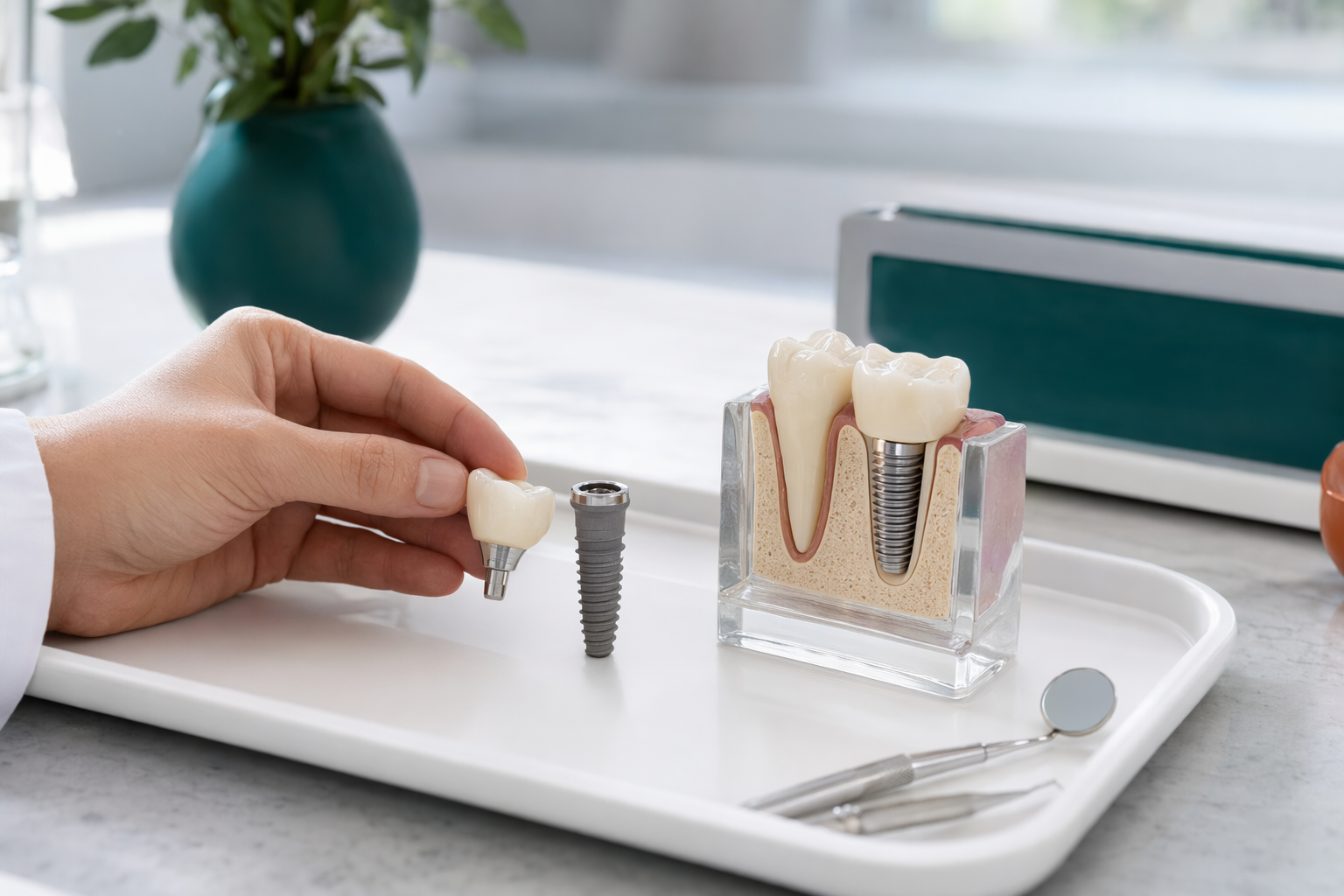
- A connector and final crown, bridge, or other tooth replacement is attached.
Each step can add time. For example, bone grafting or treating gum problems can delay the final tooth. Some offices may offer faster timelines, but faster is not always better for every mouth.
If you are comparing options, ask for the timeline in writing and ask what could make it longer. A clear plan should say what is included, what is extra, and when each visit is expected.
- Ask if bone grafting is expected
- Ask how many visits are likely
- Ask what is included in the written plan
What makes implant time shorter or longer
The timeline depends on the number of teeth, the condition of the jawbone, the type of restoration, and the area of the mouth. Front teeth and back teeth can have different planning needs. People who need several implants or a full-mouth restoration often need more time than someone replacing one tooth.
The real number also varies by city and by office. Some providers may have in-house imaging or lab steps that move faster. Others send work out, which can add waiting time. Costs can also change depending on how many visits and extra procedures are needed. For general cost ranges, see Costs.
Be careful with vague promises like “same day for everyone” or pressure to start right away. A careful clinic should explain the trade-offs, give a written treatment plan, and let you think it over or get a second opinion on a big plan.
- More steps usually means more time
- Healing time cannot be rushed safely
- Ask for a second opinion on large or expensive plans
Red flags to watch for
Some warning signs are easy to miss, especially if you are new to U.S. dental care. Watch for vague pricing, no written treatment plan, same-day pressure to start, and no clear explanation of the steps.
Also be careful if a clinic will not say who is licensed to do the work, or if they push cash-only payment without paperwork. Before starting any implant treatment, verify the dentist’s license and ask for a written estimate and timeline.
If you want help finding licensed providers, you can start with Help or Get Matched. RestoreBite only collects contact details and the restoration type you are asking about; we do not collect medical history or financial account numbers.
- Get the license name and verify it
- Get the plan and price in writing
- Be cautious with urgent pressure and unclear fees
If you need urgent care
A dental implant is not an emergency treatment. But if you have a knocked-out tooth, severe swelling, high fever, or uncontrolled bleeding, seek urgent or emergency care first.
After the urgent problem is addressed, a licensed dentist can explain what restoration options may be possible and how long each one may take.
- Knocked-out tooth: urgent care first
- Severe swelling or fever: urgent care first
- Uncontrolled bleeding: emergency care first
A dental implant often takes months, and the safest timeline depends on a real exam, a written plan, and a licensed dentist’s judgment.
Common questions
Can a dental implant be done in one day?
Sometimes a tooth can be placed the same day in certain cases, but that is not the same as the full implant process being finished in one day. A licensed dentist has to examine your mouth to see what is actually possible.
Why does a dental implant take so long?
The implant often needs time to heal and bond with the bone before the final tooth is attached. Extra steps like tooth removal, bone grafting, or gum treatment can add more time.
Is a faster implant better?
Not always. Faster treatment may be possible in some cases, but the right timeline depends on your mouth and the provider’s plan. Ask for the reasons behind the timeline, in writing, before you decide.
How do I compare implant timelines and prices?
Ask each office for a written treatment plan, the total estimated price, what is included, and how many visits they expect. Costs and timing vary by area, materials, and how many teeth are being restored.